MENU
STANDFIRST: Conservation Areas continue to offer installers opportunities in today’s market, but success depends on authenticity, precision, and the right manufacturing partner. Universal Trade Frames explains how its specialist heritage offer is helping installers win work where many competitors fall at the first hurdle.
FEATURE: Conservation Area work brings together two sets of expectations: homeowners want improved comfort and energy efficiency, while planning officers require replacements that preserve the architectural character of the building.
According to Universal Trade Frames, this combination is challenging, but installers who approach it with the right tools and an understanding of heritage design can unlock some of the best-margin projects in the market.
“It’s an area where customers expect the job to be done properly, and planners expect the product to look right,” says Richard Hammond, Sales Director at Universal Trade Frames. “When both of those boxes are ticked, Conservation Area projects become far more accessible than many installers imagine.”
Universal continues to see steady demand for premium heritage products, driven by homeowners who value authenticity and long-term performance over short-term cost.
“These customers aren’t looking for quick fixes,” Richard adds. “They want the character of the property respected. That’s why the heritage sector has remained stable, even when other parts of the market have slowed.”
Achieving Conservation Area approval depends heavily on a product’s ability to mirror the proportions, sightlines and joinery of historic timber frames. This is often where standard PVC-U solutions fall down.
Universal has built a robust reputation in this sector with its specialist heritage portfolio, which includes the Residence Collection, its own precision-engineered HeritageWeld fabrication method, and the Spectus VS slim meeting rail option.
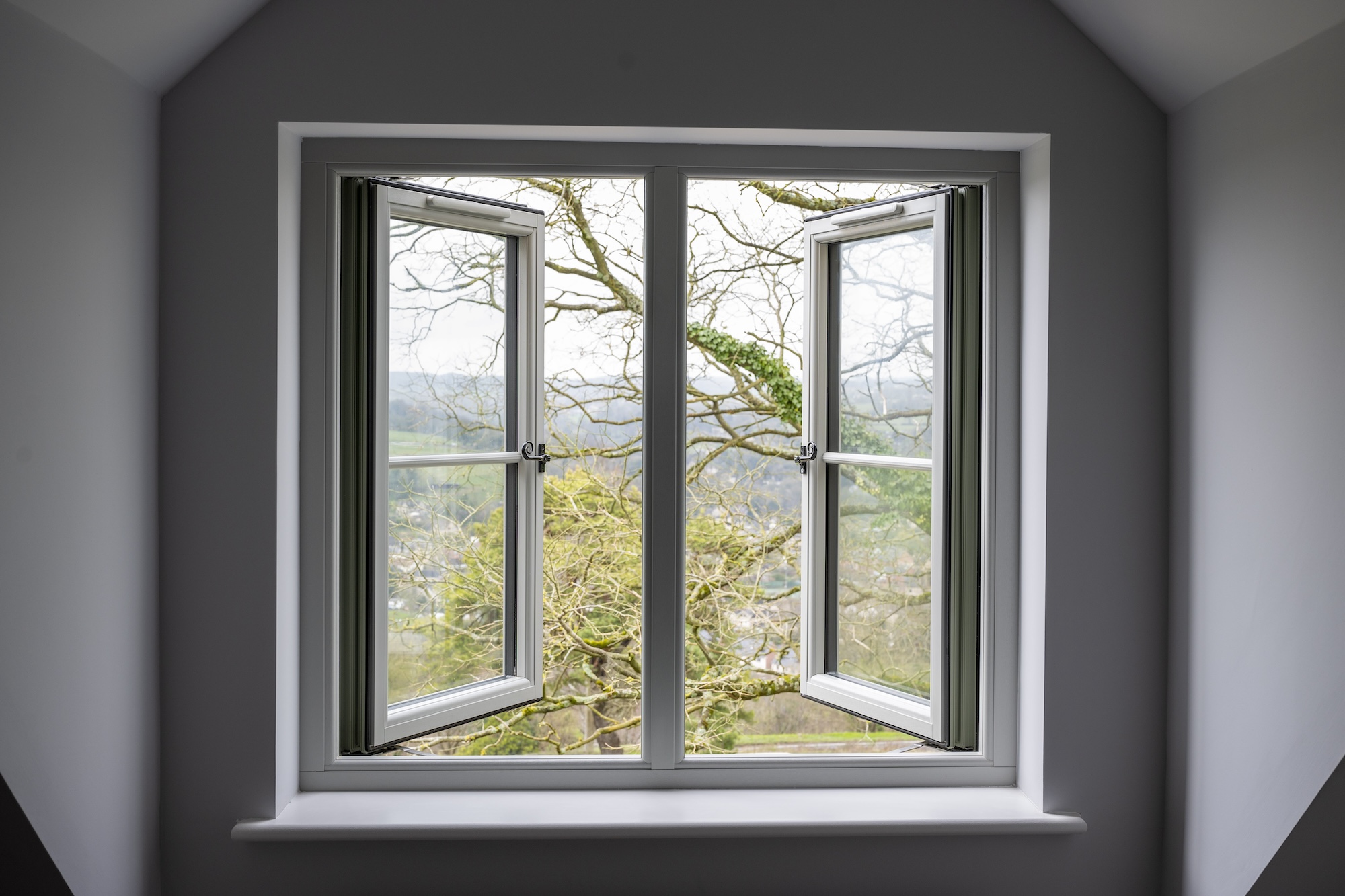
“With the Residence Collection, every detail has been designed to emulate traditional timber, from the deep bottom rail to the flush finish and period mouldings,” Richard explains.
“This is why Residence 9 has succeeded consistently where other systems haven’t. When the product looks right, planning becomes a discussion based on compliance rather than compromise.”
Residence 9 not only satisfies aesthetic expectations; it also delivers U-values as low as 0.8W/m²K, helping installers demonstrate tangible performance improvements alongside visual authenticity.
HeritageWeld further reinforces the case for approval. By achieving a fully welded 90° traditional joint with tolerances as low as 0.1mm, the method provides clean, sharp lines that mimic genuine timber joinery both inside and out.
This level of precision is made possible through six-figure investment in CNC technology, including the Haffner MAC 345 machining centre, a machine that allows Universal to compensate for foil finishes and profile variances to within fractions of a millimetre.
Older properties often present challenges not found in modern homes: openings may not be square, historic frames may have shifted over time, and previous alterations can make installation unpredictable. High manufacturing precision significantly reduces these risks.
“For installers, the biggest benefit of precision isn’t just how the window looks, it’s how smoothly the job runs,” Richard says. “If the sash sits correctly and the joins are clean, the whole installation becomes easier and more predictable.”
Universal’s non-glass-bonded manufacture of the Residence Collection is another practical advantage. Because the windows can be installed like any standard PVC-U product, installers avoid the weight and complexity associated with bonded frames and gain flexibility in how they source glass.
Universal’s new open-in timber-alternative Residence door also brings additional capability to heritage-led projects. With authentic detailing, large format sizing up to 2300mm, and Yale SensCheck smart security included as standard, it gives installers a high-end, Conservation-Area-suitable alternative to composite slabs.
Accurate technical documentation also plays a key role. Detailed drawings, U-values, section details and heritage-specific configurations help support planning submissions and speed up approval.
“Having the right paperwork is half the battle,” Richard says. “Planners want to see how the product respects the original architecture. When installers can show that clearly, the process becomes far less daunting.”
Unlike purely discretionary home improvements, Conservation Area projects are often driven by necessity: ageing timber, draughts, poor thermal performance or ongoing maintenance issues. As a result, this sector has remained stable even during fluctuating market conditions.
“It’s a space where installers can build a reputation very quickly,” Richard notes. “If you deliver one job well, especially in a close-knit Conservation Area, word spreads. That leads to repeat work, and often at a higher value.”
Universal believes the opportunity will continue to grow as more homeowners look for energy-efficient upgrades that preserve the integrity of their properties. “Conservation Areas reward attention to detail,” Richard concludes. “When installers bring the right products and a respectful approach to heritage design, it becomes a sector where quality speaks louder than sales technique, and that is exactly why the opportunities are so strong.”